

In part 2 I told how to fund your event with the aim of making a million dollars. But it is just as easy to lose it.
Let’s continue to explore the planning phase of an event. If an event is not properly planned, you will lose a million dollars after hosting an unsuccessful event.
Hey, it’s your lucky day. I am here to prevent that from happening.
Like with so many other things, in the event space you might have to jump ahead to another phase of the event process in order to finalise the current phase you in.
Before we can continue with our planning phase, we will first have to deal with some compliance issues.
These are the necessary steps that will prevent you from losing those million dollars.
I feel like there is something we should do before looking at compliance issues.
I wonder what that could be.

APPOINT A TEAM
No man is an island. We all need support from other people. Whether it be friends and family, strangers or even co-workers, we need help from time to time.
Evaluate the task at hand and determine whether or not you can actually plan and host the event by yourself. I may have appointed an administrative assistant at this point.
To host my concert, I will need a team of experts to assist me.
I typically would then divide my team up into the following sections:
OVERSIGHT (ME)
I will oversee the entire operation and ensure that each member of the team performs their required tasks.

EVENT SAFETY (SAFETY OFFICER)
The event safety officer has the role of ensuring that all the relevant regulations and policies are complied with. The event safety officer will also have the task of compiling all the required plans for submission to the relevant authorities.

SECURITY
In addition to the event safety officer, a security manager will also need to be appointed to ensure the safety of staff, patrons and other visitors to the event.

HOSPITALITY (VIP GUESTS)
This section will be responsible to ensure that VIP guests are looked after. The finer details of hosting guests will be formalised by this section.
HOSPITALITY (ARTISTS)
Similarly to hosting VIP Guests, this section is responsible to ensure that the artists receive the proper treatment.

VENDOR SUPPORT
This section will be responsible to ensure that vendors receive the required support. This section must also ensure that vendors are compliant with all the health regulations of the local municipality.
PRODUCTION
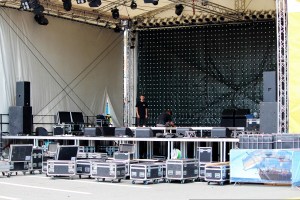
This is the real engine of the event. The production manager will ensure that all the other departments have the logistics they may require. This section may be further sub divided into smaller sections such as Technical and IT Support, Transport Coordination, Building and other related services.

FINANCE
This section controls the money. Payments to service providers and wages are two of the key items this department will oversee to ensure that proper bookkeeping is done. Financial reports often form part of partner or sponsorship agreements.

HRM (STAFF)
HRM will be responsible to recruit staff and ensure all legislative requirements are met when employing staff.

SERVICE PROVIDER SUPPORT
The appointment of service providers will be facilitated by the section. All invoices for payment must be submitted through this section who will verify with the relevant section that the work was performed, or the service was delivered. Payments will then be submitted to the finance department for payment. Any section requiring a service provider will liaise with this section.

ADMINISTRATION
This section will be responsible for medial tasks such as making copies, typing letters or managing emails or any task that may be required in support of the other sections.

MARKETING
This section will be responsible to market the event. All official communications of the event will be done through this section.
I will appoint a manager for each section, who will oversee the functions of that particular section. You could also appoint a manager to oversee a couple of sections that are similar in nature, thus reduce the number of managers you require.
You may require a legal section, but this can also be done by having a lawyer on a retainer, who you can consult when needed.
RISK GRADING
The very first interaction you will have with the Safety At Sports and Recreations Events Act or SASREA will be at this stage of your event planning.
Section 6 (3) of SASREA requires event organisers to apply to the National Commissioner of the South African Police Service for a risk categorisation of that event.
Events are categorised as Low, Medium or High risk. These categorisations can severely impact on the cost of hosting that event.
Section 6 (7) of SASREA lays out the factors the National Commissioner of SAPS need to consider when making such a categorisation.
We will delve into SASREA at a later stage but just remember that depending on the outcome of this grading, additional obligations could be placed on you as the event organiser.
This task is usually assigned to the Safety Officer for completion.
Once the risk grading has been received from the relevant SAPS Department, the next compliance issue can be dealt with.
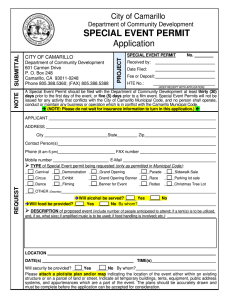
THE EVENT PERMIT
The next compliance issue that must be addressed before the rest of the planning can proceed depends on the local municipality regulations.
As I said before, this series is based on hosting events in Cape Town but specifically the City of Cape Town Local Municipality Area.
Here events are governed by the City of Cape Town Events Bylaws. This bylaw does not apply to events with fewer than 200 people, where there are no amplified sound or temporary structures erected. Please note, a Gazebo is not regarded as a temporary structure.
Or any small family or community events held on private property or purpose-built venues. So generally speaking, weddings, snack dancing, karaoke’s and the likes are excluded from this provision.
Such an application to stage an event must be submitted to the municipality’s Event Permit Office within the prescribe time frames. We will look at these time frames in detail later.

WHAT IS NEXT?
My concert has been graded as a medium risk event, so I need to submit a host of plans to the local municipality in order to receive a permit.
The absence of the permit is not crucial at this stage as you can continue the planning process and adjust your different plans as guided by the local municipality.
This is the stage of the planning process where event safety takes the centre stage.
Whilst the rest of the other sections are grinding along and doing their respective jobs, the safety officer is drafting the necessary plans that will define our safety and security protocols.
All these plans, once approved and signed off, will form part of the safety file that must be present at the Venue Operations Centre on the day of the event. We will circle back to this.
JOB ASSIGNMENTS AND TRACKING
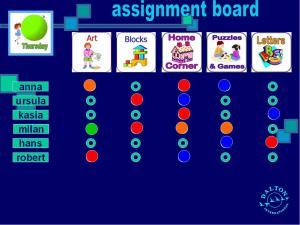
Once all your team has been established, now is a good time to draw up an assignment and tracking document or a an excel dashboard. There are also a host of apps that you can download to manage this.
Each section and manager have been assigned tasks, and it is critical to have hard deadlines. Every time you kick the can down the road for a particular task, there will be a knock-on effect on other tasks that also need to be completed.
This is where having the necessary funding in place is crucial. No section can be accomplishing any tasks if the funding for the event is delayed.
For my concert, I have big donors, sponsors and partners. Each department has got their plans in place and where required, costings are being submitted to sponsors for specific line items. As previously stated, I have insurance company sponsoring my liability cover, so my safety officer has submitted a proposal for the amount of cover we may need after consulting the City of Cape Town Municipality Events Permit Office.
Just some quick maths, I may require R 20 000 000 or $ 1 000 000 dollars in public liability insurance and that may require a premium of R 20 000 or $ 1 000. My insurance company is therefore providing me with a sponsorship of R 20 000 or $ 1 000. Unless there is a claim against the event.
Don’t worry, we will discuss public liability in due course.
Holding progress meetings is crucial when it comes to keeping the managers accountable. In the beginning meetings may be held less frequently but as the event day approaches, meeting may have to be held daily.
This not only will allow me to keep track of the progress of the different sections but provide an opportunity to address issues as they arise rather than later when things can accumulate to disastrous proportions.
Each manager should also present written plans on how each task will be accomplished.

FIELD TRIP.
Before the managers can present any plans, a field trip is required. In the bus everyone, off we go.
This is the perfect time to go for a site visit. Firstly, it allows your team to familiarise themselves with the venue.
During the initial site visit, I did when researching the venue, I had an idea of where I wanted everything to be placed. Now the team is with me, to advise me on the placement of infrastructure and identify possible problems ahead of time.
The various section managers can also determine what their needs will be in order to accomplish their particular taskings.
Decisions like the placement of the stage, VIP areas, vendors, emergency exits, egress, emergency assembly points, parking areas and the list can go on and on, can be made.
The capacity of the various holding areas, dressing rooms and VIP areas can be assessed.
We may do many more site visits leading up to the concert.
Right, so we all had a look at the venue, and everyone is ready to get stuck into their specific tasks.
Each section has to provide detail plans of how they going to accomplish these tasks.

PLAN TO PLAN
Let’s have a look at some of the plans each section may be required to submit which will later form part of the safety file.
EVENT SAFETY (SAFETY OFFICER)
An overarching Safety and Disaster Management Plan
Pre Event Risk Assessment
An Evacuation Plan and Layout
Traffic and Parking Management Plan
Bad Weather Plan
Medical Plan
Fire Rationale
Population Certificate
SECURITY
A Security Deployment Plan
An Accreditation Plan
HOSPITALITY (VIP GUESTS)
Layout of VIP area
VIP Guest list
Menu with costing
HOSPITALITY (ARTISTS)
Layout of dressing rooms and holding area
The number of artists and their entourage
Menu with costing.
VENDOR SUPPORT
A Vendor Management Plan
A Layout of the placement of the vendors
Contracts with vendors
Documents required by the local municipality such a business license.
PRODUCTION
Stage design
Lighting design
Audio layout
Layout of the spectator area
Temporary Structure Applications
Fencing Plan
Transport Plan
Catering for Staff
Production Staff Deployment Plan
FINANCE
Updated Budget
Financial Bookkeeping System
HRM (STAFF)
Staff Contracts
Staff Policy
Volunteer programme
Indemnity Forms
SERVICE PROVIDER SUPPORT
Service Provider Agreements
Job records
ADMINISTRATION
List of office supplies
List of Infrastructure required to set up a fully functional office
MARKETING
Marketing Plan
Communications Plan
Branding Plan
Broadcast Plan

I am truly on my way to staging that concert. My team has swung into full gear and are grinding away at the logistics of putting together the concert.
In part 4 we will put these plans into action and discuss the execution of the various aspects of the concert.
You are well on your way to becoming the next big name in event organising.
Are you ready to be rich?
By now you can smell those million dollars.
Leave a Reply