

You spent millions of dollars on organising the concert, but the concert was cancelled after a preventable accident occurred. You are financially ruined!
Not only have you lost millions in just organising the concert, but you are also now being sued.
How can you prevent that from happening?
The truth is you can’t. Accidents happen but you can limit your liability and still make a profit if this should happen to you.
Interested to know how? You in the right place
Up until now, we were in the planning phase, and we are ready to start executing our plans and get the concert going.
This is the right time to pause the concert for a moment and look into the Safety At Sports and Recreational Events Act.
Not only does this Act regulate safety at events, but it also places certain obligations on various role players.
These obligations added additional expenses to the cost of hosting events.


ORIGINS
Prior to the 11th of April 2001, events were regulated in a rather haphazard manner with no standardisation in South Africa.
Why is this date so important?
On that day, Ellis Park Stadium in Johannesburg, Gauteng, South Africa, a soccer match was held between the greatest rivals in South African soccer.
Orlando Pirates took on Kaizer Chiefs. For those UK readers, it would be like Manchester United vs Liverpool when this was the greatest rivalry in the English Premier League.
For my US readers, think Superbowl.
Ellis Park was 60 000-seater stadium, but according to different reports up to 120 000 spectators may have tried to gain access to the stadium. The match had begun even though thousands of spectators were trying to gain access to the stadium.
Kaizer Chiefs scored a goal, and this was followed up with Orlando Pirates equalising. This sparked a frenzy outside the stadium causing a crowd surge.
The security acted and this surge claimed 43 lives and 158 spectators were injured.
Bodies laid on the sidelines and the injured were being treated whilst play simply continued. Only after 34 minutes of play was the match called off.
What is shocking, is that in 1991 at a stadium in Orkney, also in Gauteng, a similar incident occurred in a match between the same two teams which claimed 42 lives.
Now the country took note. A Judicial Commission of Enquiry was established to investigate Ellis Park Stadium Disaster.
Whilst there was no singular factor that contributed to the disaster, the biggest contributor to the disaster was a lack of coordination and planning.
To prevent future disasters of this nature the SASREA act was introduced in 2010. This legislation has become the single most important regulatory document for hosting events in South Africa. Just in time for South Africa who hosted the FIFA Soccer World Cup in the same year.
Whilst this won’t be a deep dive into SASREA, the following information will allow you to comply with the SASREA act and protect you from liability.
But before we get there, according to Section 2 (1) of the SASREA act, SASREA will prevail over any other legislation when it comes to events. Of course, only the Constitution of the Republic of South Africa supersedes any legislation passed by the South African Parliament.


WHO IS RESPONSIBLE FOR SAFETY AT AN EVENT
Section 4 (1) says that controlling bodies, event organisers or stadium or venue owners are responsible to put safety measures in place to protect persons and their property who attends your event.
In Section 4 (2) a person referred to in the above subsection must cooperate with the Event Safety and Security Planning Committee and the VOC Commander, who performs duties prescribed in SASREA.
This is why it is important for an event organiser to know the provisions of SASREA.
According to Section 4 (3) the National Commissioner of the South African Police Service
- May direct the event organiser or person mentioned in section 4 (1) to implement additional measures to ensure a safe event.
- Must establish an Event Safety and Security Planning Committee for medium and high-risk events or any other event in compliance with SASREA.
- Must appoint a VOC Commander for these types of events
- May prohibit the sale of event tickets at the stadium or venue on event day
- May stipulate conditions for the for a high-risk event safety certificate
- May amend or replace a safety certificate
- May issue a prohibition notice to prevent or restrict access to a venue, stadium or route by a specific person or group.
- May issue a spectator exclusion notice to an undesirable spectator.
This function is normally delegated to a member of the South African Police Service within the specific province where you are hosting your event.
Section 4 (4) places an obligation on the event organiser to appoint a sufficient number of persons responsible for safety and security at the event. These persons include event safety officers, security personnel, other persons who may be prescribed by SASREA and stewards.
Section 4 (8) indicates that an event organiser must at least be 21 years of age and have the resources and experience to host a medium or high-risk event.
Section 4 (9) stipulates that the event organiser must appoint a safety officer and indicates which written safety plans must be drafted.
Section 4 (10) dictates what information must be included in the safety plans.
Now it makes a little more sense why all those written plans mentioned in part 3 are important during the planning phase. The bottom line is that as an event organiser you are responsible for safety and security at an event, however you may not always have the final say as we explore SASREA even further.

Section 5 (1) says that no person may host an event unless an application has been made for a risk grading and has public liability insurance. Section 25 prescribes the type of public liability insurance that must be sourced.
Section 5 (2) prohibits a person from obtaining an event ticket with the purpose of reselling for profit or not, use it in advertising or promotional purposes, offer it as part of a hospitality package and sell complementary tickets without the permission of the event organiser.
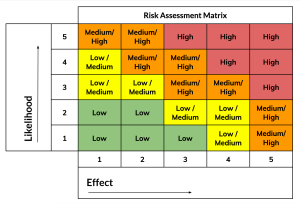
RISK GRADING
Section 6 dictates that an event organiser must apply for an event grading from the National Commissioner of the SAPS.
Section 6 (6) allows the National Commissioner of the SAPS may decline an application for risk grading if there is in sufficient information on the application.
The National Commissioner will provide the event organiser with reasons for any declination.
The following factors must be taken into consideration when grading an event:
- Popularity of the event or participants
- Expected attendance or historical attendance of similar events
- Location of the event
- Suitability of the venue or stadium to host event
- The number pf physical resources and infrastructure required for a safe event, as well as the readiness of the venue
- Historic record of similar events
- Crime statistics and trends for the area
- Threat analysis of the event
- Certified safety capacity of the stadium, venue or route
- The age profile of the attendees expected to attend the event
- The consumption of liquor
- The day of the week on which the event will be held
- The time frame of the event
- The rivalry between teams and their respective log positions and what impact the match may have for sporting events
- Any International, national, local, social, economic, political or security related factors
- The availability of police officials, emergency and essential services
- Weather or other natural conditions
- Pre-event spectator entertainment
- Any other factors the National Commissioner may consider essential
Its of course the prerogative of the National Commissioner to consult other persons before deciding on a risk grading.
As an event organiser I may request the National Commissioner to reconsider the risk grading by providing additional information such a mitigation actions on any issued raised.
If the risk grading is still refused, a submission may be made to the Appeals Board. This why it is a good idea to have a lawyer on retainer.
Luckily for me, I provided the National Commissioner with enough information and my concert was graded as a medium risk event.
Knowing what factors, the National Commissioner looks at when deciding on grading helps an event organiser to reduce the grading when appropriate. Medium and high-risk events carry additional costs for the event organiser.
I don’t know about you, but I want more money in my pocket.

As an event organiser, safety certificates may not be relevant to you. But when searching for a venue, it is important to ascertain whether or not such a venue has a valid safety certificate.
This may affect you grading and may require you to employ engineers to do a fire rational design for the venue. This could mean that you will have to put measures in place if you wish to use the venue. A population certificate may be required for non-purpose-built venues.
Always source venues that have valid safety certificates to save yourself heartache down the line.
These safety certificates determine the suitability of a venue to host events. Basically, the safety certificate protects the event organiser from liability in that the venue was suitable to host the event.


EVENT SAFETY AND SECURITY PLANNING COMMITTEE
My concert has been graded as a medium risk event. But what does that mean?
In terms of Section 15 (1) the National Commissioner of the SAPS will appoint an authorised member, in writing, who is a police official that at minimum holds the rank of Captain.
The authorised member will the appoint the ESSPC.
The ESSPC consists of the following role players:
- The Authorised Member
- Disaster Risk Management
- Event Organiser
- Venue / Stadium Owner
- Emergency Services
- Metro Police
- Law Enforcement
- Fire and Rescue
- Traffic Services
- Medical Service Providers
- State Security if required
- Provincial Health Services
- Private Security Services Providers
- Any other person deemed necessary by the authorised member
Section 15 (4) stipulates that the authorised member:
- Is the chairperson of the ESSPC
- Appoints members of the ESSPC
- Manages the powers and function of the ESSPC
- Is the overall authority to direct which measures must be in place to ensure the safety and security of the event.
Whilst the authorised member becomes the final authority, the event organiser is not released from accountability or liability for safety and security of the event.
Now I have a group of experts guiding me with regard to the safety and security of the event. I feel much better for as long as I follow common sense, the recommendations of the ESSPC and the decisions of the authorised member, my million dollars are protected.

WHAT ARE THE FUNCTIONS OF THE ESSPC?
The ESSPC must:
Consider the risk grading and make written recommendations to the National Commissioner if any circumstances changed that has an impact on the event.
This could go either way. Maybe I only sold 2000 tickets therefore it is the opinion of the ESSPC that my concert must be downgraded to a low-risk event.
Compile an event specific written safety and security plan which details the functions and roles of each role player. This safety plan is normally drafted by the authorised member and signed off by all role players on the ESSPC.
This plan assigns specific tasks to each role player in relation to event safety and security measures, the deployment of security and police officials, emergency and essential services measures, the VOC and event medical measures.
Determine measures for spectator and vehicular access control, accreditation, control alcohol sales, restrict tobacco usage, environmental control, vendor control, corporate hospitality, volunteers, access for people with disabilities, communication, spectator exclusion notices, control of prohibited or restricted items and event ticketing safety measures.
Demarcate restricted zones which requires specific accreditation or tickets.
Demarcate a dedicated zone for commercial activities around the venue.
Advise the event organiser on measures to ensure the safety and security of my concert.
Once again as an experienced event organiser, I have had the various sections of my team already draft many of these plans which I submitted to the ESSPC for evaluation and all I need to do is make the necessary adjustments.
Failure to do so would have resulted in me having to put additional measures in place that may have impacted my budget.
Knowledge allows you to protect you bottom line.
That was a lot to digest, I know but by now you can see how having this information saved you a lot of time and a lot of money.
Catch me in part 5 as we continue to surf through the SASREA act. Knowing SASREA is the key to making those millions of dollars.
Leave a Reply