
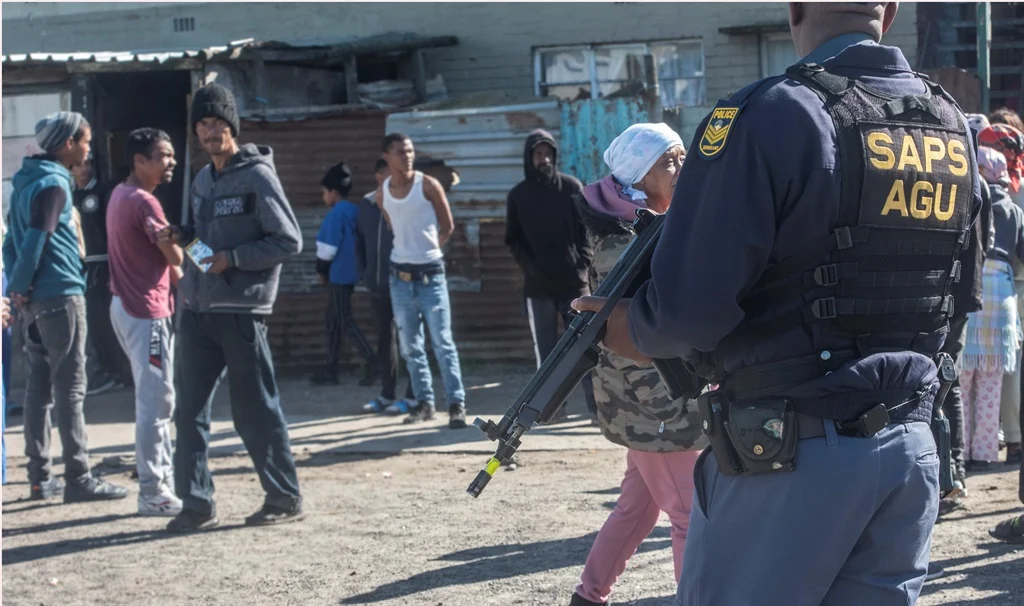
South Africa is a beautiful country filled with biodiversity, amazing wildlife, beautiful beaches and a rich tapestry of cultures. We are also a divided country, split by race, religion, politics, culture and of course money.
In Cape Town, you can just cross a road and see this divide. Yet despite these differences, South Africa still holds together as a country. We still have enough commonalities to bond together as one country.
Sadly, one of these commonalities is a negative one: crime. This crime is often accompanied by violence. From school fights to gang shootings, these incidents occur so often that we are numb to them already.
Then again, with everybody having a screen in their hands, why wouldn’t we find violence a normal part of everyday life?
After every gang massacre and every school fight broadcast to our mobile devices, keyboard warriors express their outrage and demand action be taken. Yet the next day it’s business as usual.

WHY IS GANG VIOLENCE VIEWED AS NORMAL?
For many of my age, growing up in Mitchells Plain, childhood was filled with the memory of the Anti-Apartheid struggle. As a country, we were fighting a brutal regime that subjected us to oppression and used violence to keep us subjugated. But we fought back: we blocked roads, burnt tyres and threw stones. The only gunfire came from the State Security Services back then.
In the early 1980s, gangs had already started taking hold in our townships. However, gang fights were rare and were physical clashes of small groups of men who sometimes used knives. Firearms were unknown or scarce at this time.
It is interesting to note that many of these gangsters held jobs during the day and therefore gang fights mainly occurred over weekends. I worked with gang members from Manenberg in the early 1990s, who were members of the Hard Livings and Clever Kids gangs. These gangs were the top gangs in Manenberg, fighting for control.
This made Mondays at the job site very interesting. Talk of how they beat each other up and who did what made for very interesting lunch and tea breaks. Yet there they were, working together, earning an income to support their families.
When asked why they fight each other, the answer was the same: “You belong to the gang, so you do what the gang boss says. Here we are colleagues, but at home we are gang members who are enemies.”
There was also a surge of political violence in our Black townships. Some people may remember the “Wit Doeke” (White Scarves) versus the “Rooi Doeke” (Red Scarves) in the Crossroad and Nyanga area. In 1991, I personally witnessed one of these clashes at the corner of Old Klipfontein and Lansdowne roads in Crossroads whilst travelling on a bus home to Mitchells Plain.
Mandrax and Dagga (marijuana) were the common drugs used, and of course lots of alcohol. Drug dealers were small operations with very little power in comparison with the mega-bosses we see today.
Gradually, gang bosses started consolidating power and became powerful criminal figures. In the early 1990s, as the Apartheid system was being dismantled, firearms started becoming more prevalent. It was as if a tap was opened and firearms started flooding our streets.
Sufficient evidence presented at the Truth and Reconciliation Commission, a commission that ran from 1995 to 2003 to allow both sides of the Anti-Apartheid struggle to “confess” their doings in order to bring reconciliation to the people of different races in South Africa, supports the idea that the South African Government may have funded and armed gangs during the Anti-Apartheid struggle, starting in the 1980s.
The idea was to disrupt our fight for freedom and equality by causing division within our communities. The adage goes: a divided enemy is easy to defeat.

In 1994, a miracle happened: South Africa became a democratic country without civil war, an unheard-of achievement for African countries at the time. We showed the world that transformation can be achieved through negotiations and peace.
However, our country started seeing a surge in violent crime: cash-in-transit heists, murders during home invasions and robberies, gang shootings, carjackings, and so much more.
The drug trade was also growing exponentially as our country was opened to the rest of the world. The diversity of drugs available also grew as heroin and cocaine became easier to obtain. This led to more fights over territory and control of the more lucrative drug trade.
This is the main reason why violence has spiked to the degree we see today.
So, as you can see, violence has been entrenched in our communities and has been part of our daily lives for as long as I can remember. For the majority of South Africans, this is our lived reality.
On the Cape Flats, children run towards gunfire, not away. How is this normal in any society? It is not unusual to see children continue playing their games while the police are busy at a crime scene.

WHAT FACTORS DRIVE GANG VIOLENCE?
There is a common view that gangs arose from the need to have a surrogate family and a feeling of belonging. Globally, the view is that gangs thrive where socio-economic factors such as poverty, broken families, drug and alcohol abuse, and generally poor living conditions exist.
Children are drawn to the promise of a lifestyle of flashy cars, huge homes, plenty of money and of course power. I could write a whole book on just the reasons gangs continue to exist.
However, gangs have morphed from criminal groupings in a particular area to vast criminal enterprises that resemble large corporations. This contributes to the levels of violence we see today.

1. Money
No matter the type of crime, the bottom line remains money. Allegiance and loyalty are no longer entrenched characteristics of gang culture today. Today a gang member belongs to the “Hard Livings” gang and tomorrow that same person is a member of the “Fancy Boys” gang. It’s all about who pays the best.


2. Firearms
Government wants to blame ordinary South Africans for the proliferation of illegal firearms in our communities. Yes, this is a contributing factor, but many of the firearms recovered in South Africa cannot be traced to their origin. The serial numbers are filed off and cannot be recovered forensically.
A large percentage of firearms recovered are, however, state-owned. This was highlighted by the Prinsloo case, where a former SAPS member sold nearly 2,000 firearms to gangs on the Cape Flats between 2007 and 2015. These guns were linked to over 1,000 murders across the Cape Flats.
We also see many automatic rifles R5s and AK-47s being used, especially in cash-in-transit heists. These firearms are not legally obtainable by ordinary South Africans.
AK-47s were used frequently by our liberation fighters during the Anti-Apartheid struggle. These firearms are still being smuggled across our borders from neighboring countries.

3. Corruption
It is said that “money makes the world go round.” In South Africa, corruption is just as commonplace as violence. From parliament to our borders, nearly daily we are confronted by a new corruption scandal.
Corruption may be the most empowering factor when it comes to gang violence. It’s not merely the paying off police officers to look the other way or to sell a firearm. It goes deeper, starting at our borders, where drug and firearm shipments enter our country freely.
When it is easy for the criminal underworld to get hold of drugs and firearms, the lust for money and power grows. If everybody can get drugs to sell, you must work harder to dominate the market.
In business, you eliminate your competition or execute a hostile takeover of their operations. In the underworld, you use a firearm, eliminate your competition, and take over their territory.
Corruption also erodes deterrents. The underworld uses its influence and power to bribe prosecutors, judges and prison officials. Gangs are often run from prison in South Africa due to corruption.
South Africa was shocked to learn that Ralph Stanfield, the alleged leader of the 28s gang, and his wife Nicole Johnson had received public tenders to build social housing projects for the local municipality. (To clarify: it was his wife’s company that received this tender.)
Corruption allows gangsters to operate legitimate businesses and mask their illicitly obtained money. It also costs the state enormous sums, and the resulting losses lead to poor service delivery and poor policing.


4. Coercion
Not all officials are corrupt by choice. Criminals have realized the power of coercion, which can take the form of extortion, intimidation, threats or blackmail.
In townships like Khayelitsha and Mfuleni, often unreported due to fear, public servants such as nurses and police officers are targeted by extortionists. These public servants must pay criminals a fee just to go to work. Police officers are often pressured to lend their firearms to criminals on their days off. Their families may be threatened to ensure cooperation. State vehicles are often used to transport illicit contraband.
Gangs may also entrap a public servant through enticement. Consider a married male police officer who enjoys the party scene. Gangs arrange for him to meet a young girl who appears older than her actual age, under 16, and he engages in a compromising act. The recording, or manufactured witnesses, then become leverage. The threat of criminal prosecution and damage to his marriage ensures compliance.
The final form of coercion is the simplest: do it or die.


5. Socio-economic factors
There are many socio-economic factors that push people to join gangs, with poverty being the number one factor. Poverty often leads to broken families and broken families lead to poverty — a vicious cycle.
Men father children and leave them without paternal presence or financial support. Single mothers now must provide for their children, which means the children are often deprived of parental supervision. Domestic violence also plays heavily into the breakdown of the family unit. Boys are influenced by the belief that power is achieved through violence, and this constant exposure will eventually create an acceptance of violence as a means to an end.
Other factors such as unemployment, addiction, lack of proper housing, poor education and poor service delivery also influence the culture of gang violence.
In my personal experience, socio-economic factors are slowly giving way to a new, more powerful influence, one supported by the fact that gangsterism is spreading to more middle-class suburbs where there is less poverty.

6. Social influences
The number one social influence is social media. The thug life is exalted through music and video platforms like TikTok and Instagram. Being a gangster is presented as aspirational. This is especially true in middle-class suburbs, where access to social media is easy and where more children have access to the internet than ever before.
Social media also fills the need for validation. Committing a crime on video and sharing it leads to views, likes and shares. Notoriety and popularity are becoming commodities.
The location where you live and whom you befriend may make it impossible to choose between surviving and not joining a gang. Even if you are not a gang member, living in a particular area may lead to you being labelled as one.
This is why so many young men and women are being gunned down innocently by gang members from other areas.

CAN WE QUELL GANG VIOLENCE?
My first instinct is to say no. Growing up with violence all around me, I don’t know anything different.
South Africans have had enough and have called on government to address this existential crisis we are facing. We have had enough of the shootings and needless death. We are tired of rinsing blood off our sidewalks.
The problem is that every solution thus far has proven fruitless. And now we have the army on the streets, a reminder of 1989, when the army was deployed in Mitchells Plain to suppress riots in which so much public infrastructure was destroyed.
Remember the rent offices that were bombed in Rocklands, Westridge and Lentegeur? Those explosions felt like earthquakes. And the Colored Affairs office that was burnt down, where Cedar High stands today?
The truth is that we may never truly stop gangsterism or the drug trade, but we can make our streets safer for the ordinary citizens of the Cape Flats.

MY SUGGESTIONS

1. Eliminate corruption
Unless we eliminate corruption, we will keep losing the fight. Start at parliament and our borders — stronger borders will lead to fewer drugs and guns entering our country. Tenders will be correctly awarded, and service delivery will follow.

2. Deterrents
Criminals must be too afraid to commit crime. A properly functioning criminal justice system that leads to prosecution and punishment must be in place. There must be consequences for actions. Prison sentences must be harsh. Any public servant caught for bribery and corruption must face the most severe penalties.

3. Improved Service Delivery
We need a fully functioning police service with more detectives and better policing strategies incorporating the latest technology. Social housing must provide proper living space for families. Currently these homes are built too small, with no space for children to play. Children are forced onto the streets.
When people are forced to live on top of each other, tension builds. We need access to social workers, hospitals, libraries, schools and so much more.

4. Improve the Economy
Government needs to encourage economic growth, not stifle it. We need economic policies that support small businesses and allow a free market that encourages foreign investment. The education sector also needs to be revamped. A matric pass requirement of at least 60% is needed to be competitive internationally. Promote vocational studies alongside academics. We need tradespeople and engineers, not only lawyers and social media influencers.
A South-Africa-first mentality needs to be fostered in the manufacturing sector. End the unsustainable social grant system and replace it with one that supports only the elderly, disabled and children in genuine need. A youth unemployment grant is entrenching a poor economy.

5. A change in mindsets
This is the most difficult suggestion. How do you convince our youth that violence is not normal? We need more influencers who promote positive content and inspire people to seek employment and build success rather than chasing instant wealth through drugs and crime. Monitor your child’s social media consumption. Use social media to show the harsh consequences of a criminal life.
Stop saying “there is nothing I can do” and stop being a silent witness to these brutal killings. The police need to strengthen their social crime-prevention efforts. We need to rebuild actual communities and places where neighbors support each other and together uplift their surroundings. Hold each other accountable.

FINAL WORD
Unfortunately, I don’t see any major drop in gang violence in the near future.
However, we may reach a tipping point where society becomes totally lawless before it becomes law-abiding again. A post-apocalyptic dystopia where the streets are ruled by the sword and mob justice is the norm. I don’t support vigilantism.
Government needs to listen to the pleas of its citizens.
Leave a Reply