
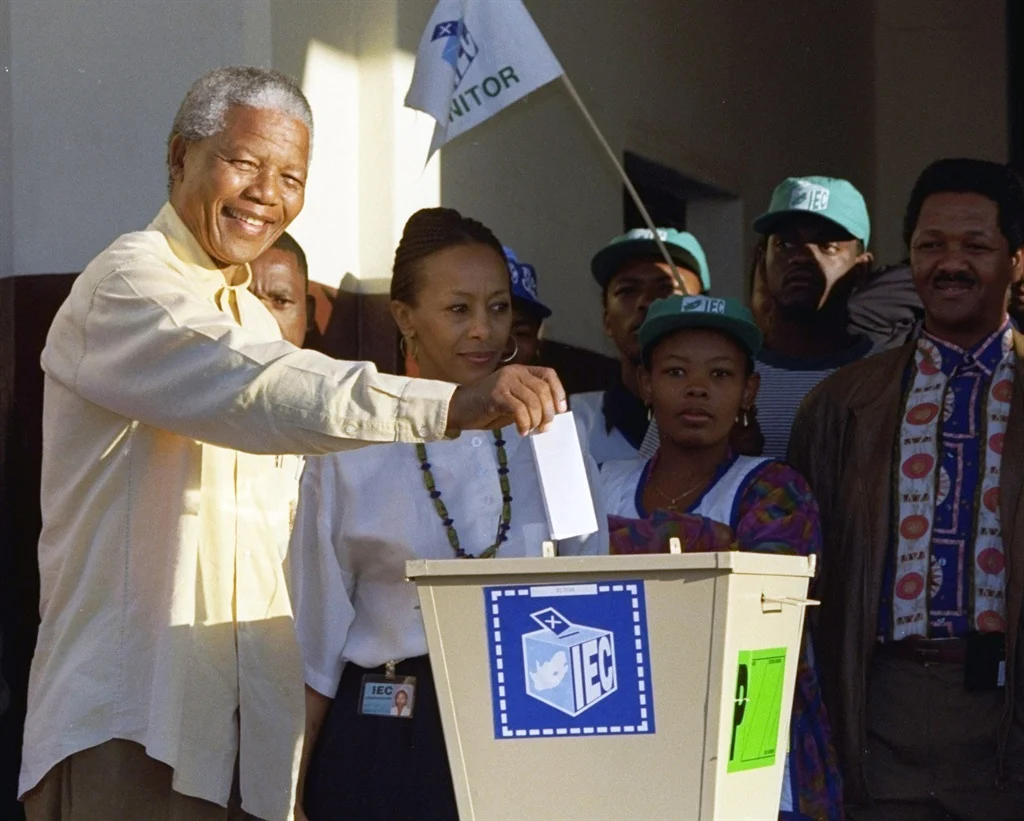
South Africa is gearing up to cast their votes in the 2026 Local Government Elections which is set to take place later in the year. As with any elections, the campaigning is under way.
Every political party is highlighting the failures of the other contesting parties. Round about 508 political parties have registered to take part in these elections, according to the Independent Electoral Commission of South Africa, as of November 2025.
Many of us may continue to vote as we have historically, whilst others are mulling over supporting a new party. Is your party meeting your expectations?
Local government is the grassroots of service delivery. The provision of electricity, water, refuse removal, roads and all our basic infrastructure is done by the municipality.
Although local municipalities do provide social housing, provincial and national government plays a bigger role in this.
Your local ward councillor is the face of this service delivery or the failure thereof. Choose wisely this time around.
In the bigger metropoles, community safety is also another major issue where the local municipality plays a big role in.
Let’s look at the battle for Cape Town.
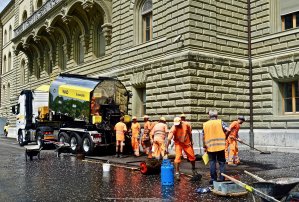
Service Delivery
Cape Town is seen as the city of two classes.
At the time of writing this article (20th April 2026), Cape Town is living up to its name, “The Cape of Storms”, as the city has been battered by inclement weather for the last four days.
Localised flooding has been reported in many areas and in some areas, people are literally trapped in their homes. Others have had their homes flooded. In places like Du Noon, near Milnerton, cars have nearly been completely submerged in water, which gives you a clear indication of the levels to which flood water rose.
This flooding is largely attributed to the blockage of stormwater drains. It seems that the local municipality may have failed to clean these systems ahead of this heavy rainfall that occurred over the last 96 hours. In all fairness, the City of Cape Town normally does embark on a winter readiness program that sees that the stormwater drainage system is cleaned ahead of the winter season. They may have been caught off guard as we not exactly into our winter season yet.
The conditions in informal settlements are atrocious and has highlighted the need for proper formal housing opportunities. Disaster Risk Management agencies are currently assessing the damage cause by the floods.
In July 2025, similar flooding left over 4000 people without shelter in Cape Town, mainly people from the informal settlements. The City of Cape Town is aware of the historical struggles of people in informal settlements.
For most part Cape Town is a well-functioning city, and residents do receive proper services, if you live in the more upper- and middle-class suburbs. The perception is that the City provides better services to the people in Constantia and Bishops Court than in Khayelitsha or Blikkiesdorp. Is this true?
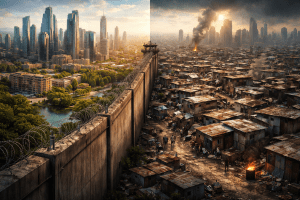
Two Classes
Whilst it is easy to blame the City of Cape Town for a lack of service delivery, is that the case?
The lack of housing is normally the first point of criticism when it comes to service delivery. There is roughly a shortage of 620 000 housing units in the Western Cape with approximately 300 000 specifically in the city as of 6 February 2025. Most of the housing units are being built in the more impoverished areas and these developments have been hampered by tender corruption and extortion.
Migration to the Western Cape and the uncontrolled rise of informal settlements are exacerbating the situation.
There is a push back by many social advocacy groups that the current model of not building social housing in the more affluent areas is subjugating our communities and ensuring they remain impoverished. This is often referred to as the “Apartheid Spatial Planning”, the idea of dividing communities along racial lines although today, it’s more about money and class.
In some corners, this advocacy is seen as socialism and anti-capitalism as the accumulation of wealth is regarded as oppression of the masses. In their current situation, how does that help our poor? I agree that people should be able to get to their places of employment easily or live closer to reduce the cost of having a job.
Cape Town is regarded as a world class tourist destination, given the beautiful views, clean beaches and Table Mountain. Cape Town also attracts a lot of international events.
Cape Town is thus the crown jewel of the Western Cape. The closer you get to Cape Town the more expensive it gets to live. Property values are higher and is not within the reach of the average citizen. Is this wrong though?
If we look at other major cities around the world, all of them have so called slum or impoverished areas. Do we want to go the way many other cities in South Africa is going? Hijacked and Derelict building that are chasing investors out of these spaces.
Due to poverty and our drug problem, many middle-class areas are also facing the problem of derelict buildings, drug hotspots, criminal dens and other forms of anti-social behaviour. Gangsterism has run rampant in these areas. Good fences make good neighbours.
Solid waste management is also another point of contention. A drive through many townships reveals waste lands where refuse is heaped up on open fields and there seem to be no collection services at all. Is there really no collection of garbage at all?
It is own behaviour that contributes to this perception. The City of Cape Town does in fact clear up these spaces, only for dumping to take place there within hours again. In Mitchells Plain garbage is collected on a weekly basis, nearly without fail, yet there are many open spaces, especially in the more impoverished areas, that are still used to dump common household refuse.
Each household has been given a 240l wheelie bin for this purpose. However, these wheelie bins have become Light Delivery Vehicles for the poor. These bins are used to transport a variety of goods other than for storing garbage for collection.
Garbage often makes it way into the stormwater system in these areas, which in turns facilitates localised flooding when there is heavy rain. Garbage is often disposed of in the sewerage system and leads to this system backing up and spewing sewerage all over the place.
Then of course there is the crime factor. The police respond quicker to complaints in the more affluent areas than in poorer areas. Our lives in the township doesn’t matter to government.
This statement is absolutely true; the police do respond quicker in Bishops Court than to complaints in Bishop Lavis. But it’s not for the reasons you may think. The truth is that the number of police personnel to the population ratio may be relatively the same.
Let’s put that in perspective, in Bishop Court, the police station has 5 members per shift, whilst in Bishop Lavis, their police station has 30 people per shift. The difference in the number of police personnel between the two areas is 1:6. Let’s say that gives you a ratio of 1 police officer to 416 citizens These figures may not be accurate and is used for comparison only.
In most cases the actual police to citizen ratio may be much higher due to staff shortages. The problem is that this ratio does not factor poverty and other social ills that may be present in these different communities, into the equation.
Being an affluent area, the number of complaints attended to in Bishops Court is drastically lower than in Bishops Court. Let’s say this difference to 1:20, for every one complaint received in Bishops Court, twenty is received in Bishop Lavis.
For every one police officer Bishops Court has, Bishop Lavis has six. Then for every one complaint attended to in Bishops Court, the police must attend to twenty in Bishop Lavis. While Bishop Lavis may have six times more police officers, the area also has twenty times more complaints to attend to.
By now you should get the problem, twenty times more work with only six times more personnel. Surely this clearly starts to explain the difference in the reaction time between the two areas.
Then you also must factor in crime profile of the two areas. In poorer areas, cases of domestic violence are much more prevalent, along with drug abuse and gangsterism. Alcoholism also plays a big role in how busy the police are in a particular area.
Therefore, data does not support an imbalance of policing between the more affluent and poorer areas based on class or status. This would have been the case if both stations had the same amount of personnel where Bishops Court have less people residing in the area.
The City of Cape Town does have some pro poor policies such as indigent grants and limited free services like some free electricity units per month.
The equality that exists is in how much everyone contributes to these services. The middle-class seem to be contributing the most. The rich are often incentivized by getting reduced rates and taxes but are still paying big sums of money. The equality rests in the ratio of income the middle-class have to spend on municipal services in comparison to the rich and the poor.

The Politics
The City of Cape Town has been under the control of the Democratic Alliance for roughly the last 15 years. The question you need to ask yourself is, has my community improved during this time or has there been a degradation of services?
Then the next question will be, can another party do better?
Let’s look at the contenders. The ANC will always be the next choice for many, although the party has suffered a major loss in support, during the last two elections. The track record of the ANC in local and national government has been fraught with a lack of service delivery and allegations of corruption.
The EFF and Cope have not done must better in the areas they have sway. The IFP seem to be holding steady in Kwa-Zulu Natal but is unlikely to have an impact on Cape Town.
Then there is the “Coloured” block. The likes of the NCC, Good and PA. The identity of these parties is linked to the “Coloured” (mixed race) people of Cape Town and parts of the Eastern Cape and Gauteng. Although some may argue that the “Coloured” people are the direct descendants of the Khoi and the San, the aboriginal people of the Western Cape. So, the appeal of these parties is limited to a specific voter base. These parties do have good war cries and are likely to get some traction amongst Cape Town voters.
There are other parties like ActionSA, Mzansi, ACDP, UIM and many more who may be able to court some of the Cape Town voters unsatisfied with the performance of the DA specifically because of the ongoing gang violence still going on despite the army being deployed to the Western Cape.
Then of course there is the Freedom Front Plus, but once again they are identified to be a party representing one race, “White” people. They will also limit their appeal to the “Coloured” and “Black” voters who may consider whites as the cause of their current problems.
The days of one-party rule in local, provincial and national government has seemingly come to an end in South Africa. This is evident by the results of the last two elections. Coalition governments are the new trending fad. Is this helping or hindering service delivery?
Coalitions only work where there is mutual respect amongst the parties in the coalition. Unfortunately, at local government levels, coalitions seem to be like speed dating. After five minutes you move on to your next date.
Small parties are joining the election process to become so called King Makers, so long as they hold a seat or two, they can have a proper role in local government. Be careful who you kiss, Prince Charming could turn into a frog.

Considerations
From the outset, voting in the 2026 Local Government Elections should be for improved service delivery in the area where you live.
Consider the following:
Does the party I wish to vote for have a proven track record of service delivery? The party, where it has had the opportunity to deliver, did or did not deliver on previous promises.
Are the promises made by other parties plausible, if they were given the mandate? The party has the necessary expertise to deliver. The party leadership is made up of people who actual could govern and have the necessary knowledge and skills.
Will voting for my party lead to a coalition government? Coalitions rarely work and often midway through splinters and leads to a change in the dynamics of the municipality. New mayors and speakers of council cost money. The size and influence of the party you vote for, plays a pivotal role in making your choice.
Is the party I voted for, solely responsible for the lack of service delivery? We must acknowledge how our own behaviour contributes to a lack of service delivery. Whether it be because we contribute to crime, corruption and new informal settlements through illegal land invasion, we may be the problem. Start by not littering.
To Vote or Not to Vote
My vote doesn’t count; they don’t listen to me anyway.
Stop right there, your vote does count and more importantly it matters. We can only affect change if we part of the system.
If the party you voted for, failed you, vote for another party. This may not be because you like another party but because that previous party need to be held accountable.
This will ensure that for the next five years, your party will seriously have to improve to win your vote back. Election promises must be a social contract we enter when we vote for that party.
Only through voting can we hold our political parties accountable and ensure effective service delivery.
PS: The IEC has announced there will be a voter registration weekend on 20 and 21 June 2026. Register to vote!

Leave a Reply